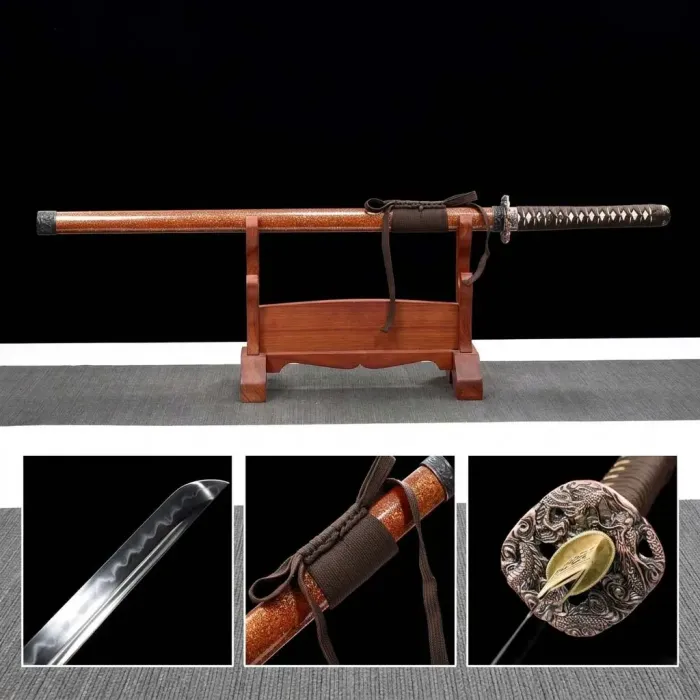
A heritage oriental sword serves as a impressive display of technique, but how about you strive for to show your separate flair? Altering your blade is a enriching journey, allowing you to forge a truly rare piece. From the handle wrapping and fastening to the tsuba design and tempering curve, each aspect offers a chance for tailored look. This study delves into the territory of katana modifications, providing guidance for both rookies and skilled enthusiasts searching to leave their footprint on the classical art of the samurai.
Newcomer's Original Fabrication
For people excited to embark on the advantageous journey of katana handling skills , 1060 steel katanas bring an superb entry point. This distinct grade of essential steel strikes a nice compromise between value and proficiency. While not as hard as top-tier steels, 1060 facilitates a fair level of whetting, making it appropriate for learners to acquire the foundations of blade preservation and appreciate the elegance of handcrafted Japanese weaponry. It’s a excellent choice for establishing experience without the fiscal burden of more premium steels.
T Gear Steel Cutlasses: Combining Performance and Affordability
For hobbyists seeking an authentic sword experience without exceeding the budget , T10 alloy katanas represent a compelling option. These tools offer a noticeable improvement in durability compared to lower-grade alternatives, exhibiting decent edge retention and fair flexibility for rudimentary slashing techniques. While not rivaling the eminent characteristics of superior steels like T100 or folded iron , T10 provides a notable blend of ability and reasonableness , making them a trendy choice for novices and those on a restrained income .
Going past the Sharpness : Adapting Your Blade's Hardware and Tsuka
Considering the finished sword is undeniably the central point of a katana, truly enriching its elegance lies in the cautious customization of its hardware and grasp . This method allows collectors to express their exclusive flair . Consider the comprehensive possibilities: menuki - decorative accents that enhance visual beauty ; the hamon sleeves – often delicately chiseled; the tsuka core itself, wrapped in time-honored ito lace ; and the fusa finial , which can be fashioned from various materials like ornaments or bone .
- Adopt styles that match with you.
- Test with distinctive elements .
- Prioritize excellence for a durable effect .
To conclude, customizing these components transforms a mesmerizing weapon into a authentically one-of-a-kind work of creation .
The Love of the Katana: Antiquity, Formation, and Composition
The oriental cutlery shows a distinctive allure, steeped in eras of Japanese history and legacy . More than merely a contraption of battle , it's a token of the fighter class ethos – a fusion of mastery and governance . Its unfolding spanned numerous generations, with early cutting instruments evolving into the sleek-lined curvature and lethal edge we identify today. The manufacture involved is truly remarkable , requiring decades of mentoring to achieve . The process involves a complex folding of forged iron , creating layers that boost the steel’s flexibility and cutting ability. Multiple schools of crafting appeared , each with their separate secrets and techniques for achieving the perfect stability and precision - a truly exacting pursuit.
- Former Katana designs
- The role of the nihonto in fighter culture
- Heritage blacksmithing systems
Determining the Right Steel for Your Weapon Project: 1060 vs. T10
Identifying the favorable steel is absolutely important for any katana project, and the decision between 1060 and T10 can be tricky. 1060 is a popular American steel, offering a good balance of hardness and toughness, making it relatively easy to heat treat. However, T10, a Asian steel, commonly boasts amplified wear permanence and can probably achieve a superior definitive hardness, although it can be more tough to treat samurai sword and requires thorough heat forging. Consider your competency and projected results: for a beginner, 1060 may be a prudent inception, while the veteran smith might prefer the enhanced properties of T10.
- Accessibility of Operating
- Erosion
- Conclusive Strength
Revealing the Strength: Expert Katana Improvement Strategies
Perfecting the skill of sword tuning extends far beyond basic stropping. Serious professionals are now investigating advanced techniques to truly unlock a blade's hidden potential. This comprises intricate work with the quenching mark, utilizing specialized materials for differential condition and carefully picking the geometry of the shield to optimize balance and effectiveness. Beyond purely functional enhancements, artisans are increasingly focused on reaching unparalleled aesthetic beauty, through complex decorating and layered surfaces that truly transform a katana into a exquisite object.
From Raw Steel to Masterpiece: Crafting a 1060 Katana
The journey initiates with common 1060 material , a durable material far absent the beautiful katana it will mature into . Master bladesmiths execute a involved process of overlaying and shaping the initial steel, repeatedly heating it and forging it to purify impurities and develop a symmetrical grain structure. This laborious process, often spanning for cycles, builds the required force and pliability characteristic of a bona fide Japanese tool. Subsequent heat adjustments , including careful hardening and quenching , are fundamental to achieve the expected harmony of sharpness, permanence and splendor .
- Layering: Minimizes impurities and constructs grain structure.
- Constructing: Forms the steel into the initial blade form.
- Quenching: Controls the final hardness and flexibility.
The Continuing Pull of the Katana: Comprehensive Review of Metalwork and Tailoring
Such established katana remains a captivating symbol representing Japanese civilization , its enticement far beating mere weaponry . Forged from a special steel and sometimes featuring intricate motifs , the procedure of creation itself is a honored art. Beyond the essential craftsmanship, the ability to reshape a katana - from the patterning to the grasp wrapping and habaki - allows for a genuinely individual statement for both admirers and wielders alike. This integration of long-established steelwork and boundless personalization produces the katana's continued fame across the earth .

Comments on “Can a performance‑oriented katana content hub boost SEO and authority?”